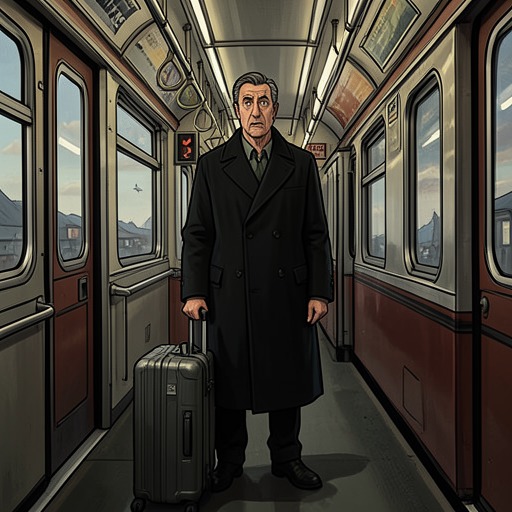
The Prince’s belief in his own luck
Bullet TrainThe Prince’s belief in his own luck is more than a hope that danger will pass: it is a working explanation for his survival, a guide to interpreting events, and a source of confidence in his ability to control other people. When circumstances turn against him, he searches for a protective meaning in them; when he anticipates danger, he treats his previous escapes as evidence that he will survive again. The belief reaches its sharpest test aboard the Shinkansen, where a seemingly fortunate escape from a rigged gun gives way to an unforeseen snake and the fear that his luck may have deserted him.
The logic of a fortunate life
The Prince understands his past as a record of protection. He has been kept safe by what he regards as an exceptional surplus of luck, and he expects that pattern to continue. This confidence is not merely retrospective: it shapes his judgment of present risks. He assumes that people and animals tend to behave as he wants them to, and he treats his own past survival as a reason to expect future escape. The conviction thus supplies a personal logic for events that might otherwise appear random, while encouraging him to underestimate what he cannot control.
His interpretation is especially visible when Tangerine offers him a gun and calmly explains how to operate it. As the Prince prepares to follow the instructions, the weapon slips from his hand and falls. The moment initially produces panic: he expects Tangerine to use the opening to attack. But the Prince also wonders whether the mishap means something. Because such an error occurs at a crucial instant, he decides it was probably necessary—a mistake that has protected him rather than endangered him. His established belief turns a loss of control into evidence of protection.
The gun and the recovery of confidence
The Prince’s interpretation leads him to reconsider the weapon. Instead of proceeding, he tells Tangerine that he does not need the gun and holds it out for him to take back. The Prince cannot identify the technical defect, but he senses that something about it is irregular and imagines that firing it would hurt him. Tangerine then confirms that it is an Exploding trap pistol: pulling the trigger would cause it to explode and badly injure the person holding it, though Tangerine does not think it would be fatal. The Prince has recognized a real danger without understanding its mechanism.
That recognition changes his attitude toward the immediate confrontation. His sense of accomplishment is not only relief at having avoided the trap; it renews his trust in the protective force he calls luck. He decides that he is no longer afraid of Tangerine and even suspects that Tangerine may now be starting to fear him. The episode shows how quickly his confidence can return when a threatening event seems to confirm his private explanation of survival. Luck, in this reading, functions like a shield: it converts danger into proof that he is protected and makes him feel powerful in the face of an opponent.
Luck as prediction and leverage
The Prince also uses his belief to forecast events beyond the immediate encounter. A missed call appears to have come from the man at the hospital in Tokyo, who had been instructed to proceed with a job if the Prince did not answer after more than ten rings. The Prince knows that the phone has rung far beyond that limit. He cannot be sure the man will act, but his experience of a lucky life makes him expect that the man is already heading toward Wataru Kimura’s room with murderous intent. His confidence is joined to a concrete arrangement and an unanswered call, but the outcome remains uncertain at this point.
Rather than disclose this danger to the older couple with him, the Prince considers how the news could be used. He anticipates that telling them too soon would provoke the old man to act and might lead him to contact the hospital. The Prince therefore decides to keep the information hidden for a while, imagining that he can reveal the tragedy later and exploit the couple’s shock and guilt to weaken their ability to make decisions. His belief in luck accompanies this calculation, but it does not make him passive: he treats the expected outcome as an opportunity to manipulate others. Confidence in being protected and a desire to control the people around him reinforce one another.
As the train approaches Morioka, the Prince similarly imagines how he will escape if events erupt into chaos. He expects Nanao to aim the gun and plans to jump toward the aisle at that moment. He cannot guarantee that he will avoid harm, yet judges the chance of injury to be low and relies on the familiar thought that he always makes it out safely. The impending arrival at Morioka gives this expectation a specific deadline: an announcement says the train will arrive in five minutes, and the Prince believes that the sequence of events will then unfold in a way he can survive.
The snake and the threatened belief
The sequence does not follow the Prince’s expectations. Nanao suddenly shakes his arm and cries that something will not come off; a woman suggests using water, and Nanao rushes through the door into the gangway. The woman laughs, while the old man remarks on the snake and calls Nanao unlucky. The Prince is confused: the snake has appeared without warning, and he cannot fit it into the course of events he anticipated. His reaction includes anger and dread, as he fears that his good luck has been caught and torn apart by a force of misfortune.
The contrast with the earlier gun episode is decisive. There, an accident seemed to the Prince like a necessary mistake that had saved him, and his confidence grew when Tangerine verified the danger. Here, the snake is not something he has interpreted in advance or turned to his advantage. The old man’s buoyant laughter adds to the disturbance: he looks upward, smiling broadly, and says that someone is there. The Prince’s belief has not yet been disproved, but its certainty is shaken by events that resist his predictions.
What the belief reveals
Nanao’s account of his bad luck provides a personal contrast. When Nanao says that, compared with his usual misfortune, what has happened is not so serious, the Prince hears a sad heroism in his tone and recognizes that Nanao is trying to persuade himself. The Prince wonders whether Nanao’s luck has left him and come to the Prince. Yet he cannot understand what it is like to be unlucky and cannot find the right words. Luck therefore separates them as much as it connects their situations: the Prince can entertain the idea of misfortune changing hands, but cannot inhabit Nanao’s experience of it.
Across these episodes, the belief works both as a defense against fear and as a lens that makes the Prince overconfident. He reads the dropped gun as protection, relies on past survival when anticipating the danger to Wataru Kimura, and expects to escape the coming confusion at Morioka. The snake reverses that pattern by making contingency feel threatening rather than reassuring. The supplied scenes leave the question unsettled: the Prince’s belief remains powerful, but the unexpected event makes him confront the possibility that luck cannot be commanded or reliably predicted.